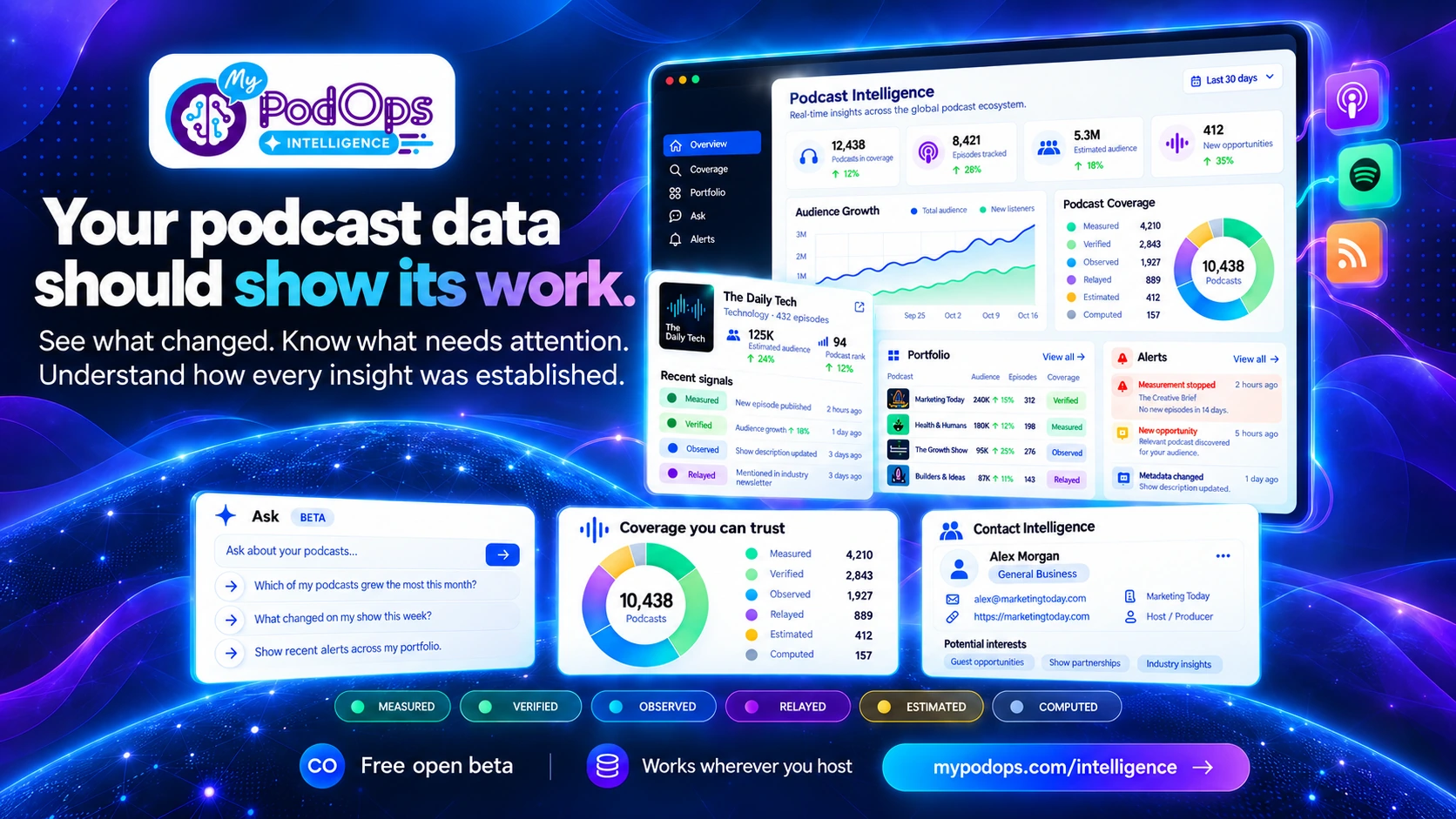
Every podcaster knows the routine. You publish an episode, wait a day, open your dashboard, and look at a number. Downloads went up, or they went down, or they did something weird you cannot explain. Then you close the tab and make your next decision the same way you made the last one: by guessing.
That routine is not your fault. It is what the tools gave you. Podcast analytics were built to answer one narrow question: how did your audience behave? They were never built to answer the questions that actually keep you up at night.
Is this number real, or is half of it bots? Did something change with my feed this week? Is my measurement even working right now? What is happening with the other shows in my space? Which of my shows needs attention before it becomes a problem?
We built MyPodOps Intelligence because those questions deserve real answers, with the evidence attached.
The why: three problems with podcast data today
Problem one: a lot of the numbers are not real. Raw download counts include automated traffic, bots, and repeats. A download is not a listener, and a count that cannot tell the difference is not a measurement. It is a rumor with a decimal point. When sponsors, networks, and creators make decisions on those numbers, everyone downstream pays for the fiction.
Problem two: changes happen silently. Feeds move. Shows switch hosting providers. Redirects break. Measurement stops reporting. Most podcasters find out weeks later, usually when a sponsor asks a hard question or a chart looks wrong. The podcast world does not stand still between your episodes, but your dashboard pretends it does.
Problem three: your show does not exist in a vacuum. Your analytics know nothing about the market your podcast sits inside. They cannot help you research a show, evaluate a partner, watch a category, or understand whether a change is just you or everyone. So creators end up making market decisions with no market information.
The what: an intelligence layer, not another dashboard
MyPodOps Intelligence is a continuously updated picture of the podcast ecosystem, organized around the podcast itself rather than the hosting company. It works whether you host with MyPodOps or anywhere else. It does four things, and they build on each other.
- Discover. Search a global podcast index by name, author, or topic, and open what is publicly known about any show, not just your own.
- Monitor. Keep the shows you care about under continuous observation: new episodes, feed moves, hosting changes, publishing cadence, and whether measurement is still reporting.
- Verify. Every figure carries a label saying how it was established.
- Act. See what actually needs attention, and what the evidence supports, so your next move is a decision rather than a guess.
Verify is the part we care about most. Measured means PodOps measured it directly. Verified means it was confirmed at the source. Observed means it was seen publicly. Relayed means a third party reported it. Estimated means it was modeled. Computed means it was derived from other facts. And when something has not been established, it shows as not available.
We never turn "we don't know" into a zero, because a zero is a measurement and a blank is an admission, and treating one as the other is how reporting quietly becomes wrong.
On top of that sits Ask Intelligence. Ask a plain language question about your connected podcasts, like "Which of my podcasts changed this week?" or "Which shows need attention?" or "What happened to this feed?", and get an answer that shows its work. If you disagree with an answer, you can go and check what it was built from. That is the difference between intelligence and a chatbot with opinions.
The value: trust, time, and better decisions
The value is not more data. Podcasters are drowning in data. The value is knowing which data deserves your trust, catching the changes that matter while they are still small, and spending your limited hours on the move the evidence actually supports.
Your private audience measurement stays private, too. Where a show is measured by PodOps, those figures are a different class of fact, measured directly with automated traffic and repeats excluded, and only a verified owner of that podcast can ever see them. Public information is used for discovery and context. Private measurement never becomes public just because a feed is public.
How different podcasters can use it
If you are a solo creator: connect your show and check the thing nobody checks, whether your measurement setup is healthy. Turn on alerts so a feed problem finds you before your listeners do. Once a week, ask what changed. That two minute habit replaces an hour of dashboard anxiety.
If your show is growing: use Discover to understand your category properly. Who else is publishing, how often, and what changed for them? Use monitoring to watch your own publishing patterns and catch a quiet feed issue the day it happens, not the month it happens.
If you run several shows or a network: the Portfolio view puts everything you monitor in one place, with changes sorted across shows. Ask which of your shows needs attention and get an answer ranked by evidence, not by whoever emailed you loudest. One identity and one history per show, regardless of who hosts it, means a show that moves hosts does not lose its past.
If you work with sponsors, agencies, or partners: research shows before money moves. Check a show's publishing consistency, its hosting and feed history, and whether its numbers carry a measured or verified label, or whether they are simply reported. In a market where anyone can claim any audience, provenance is due diligence.
If you book guests or pitch yourself as one: look a show up before you pitch it. See what it actually publishes, how it is structured, and whether it is active. Better research makes better pitches, and better pitches get answered.
Getting started takes one step out of five
The flow is Discover, Connect, Measure, Understand, Act, and you only have to do one of them: connect your show and confirm it is yours. That single step is what unlocks everything private. From there, measurement turns on, your shows get watched continuously, and Ask Intelligence starts answering questions about your own corner of the market.
Create your free account at mypodops.com/intelligence and connect your first podcast. Then ask it the question your dashboard never could: what changed, and how do you know?
Because your numbers should be able to answer that.